CACHE
You are here
Digital Experiments on the LearnChemE website
Web-based, interactive digital experiments have been developed at the University of Colorado Boulder with support from the National Science Foundation and in collaboration with Washington State University. Currently, 26 digital experiments are available on the LearnChemE website at https://learncheme.com/virtual-laboratories/, and three more will be added soon. Additional ones are under development.
Figure 1 shows the digital experiments for heat transfer and fluid mechanics. Seven of these experiments are identical to the low-cost desktop learning modules created at Washington State University: https://labs.wsu.edu/educ-ate/desktop-learning-modules/. The desktop modules and the digital experiments are designed to be used in a 50-minute class by groups of students.
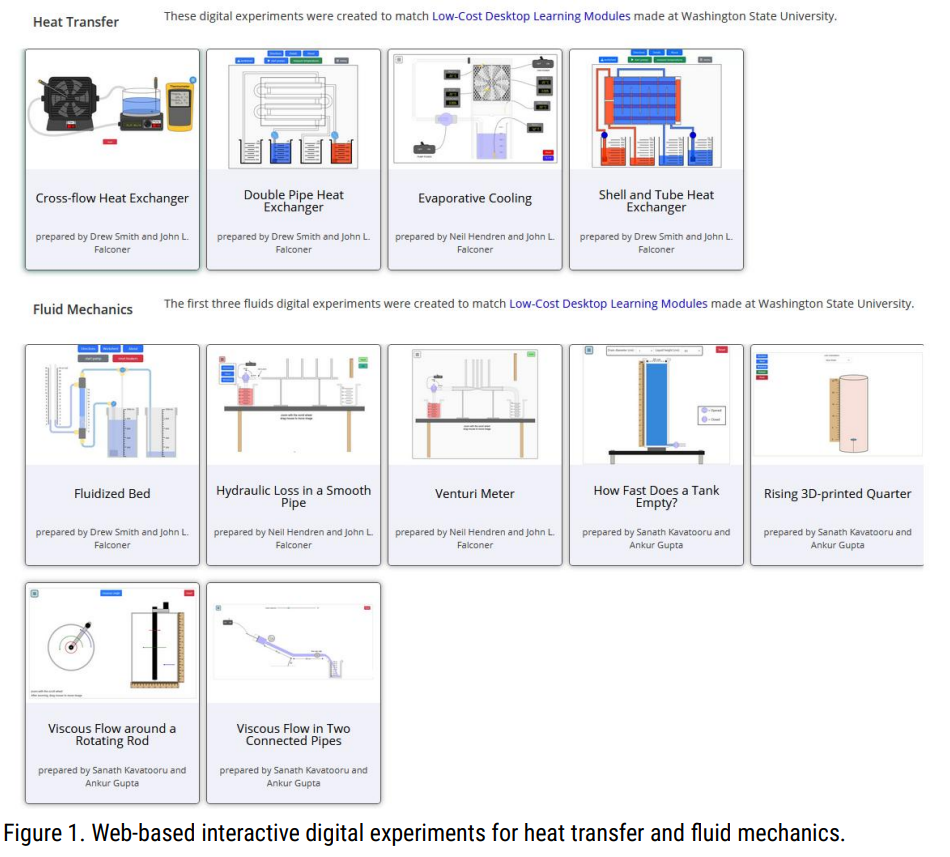
Web-based digital experiments were developed to make these experiments more widely available, and universities do not need to purchase the physical experiments. A comparison between a physical experiment and a digital experiment was carried out in a classroom in which half the 2 student groups used physical experiments, and half used the corresponding digital experiment. Preliminary results for pre- and post-tests show that student learning was the same for both types of experiments.
Figure 2 shows digital experiments for material and energy balances and thermodynamics. A few could also be used in a separations course. Though these experiments do not have a corresponding physical experiment, they were also developed for use in a 50-minute classroom.
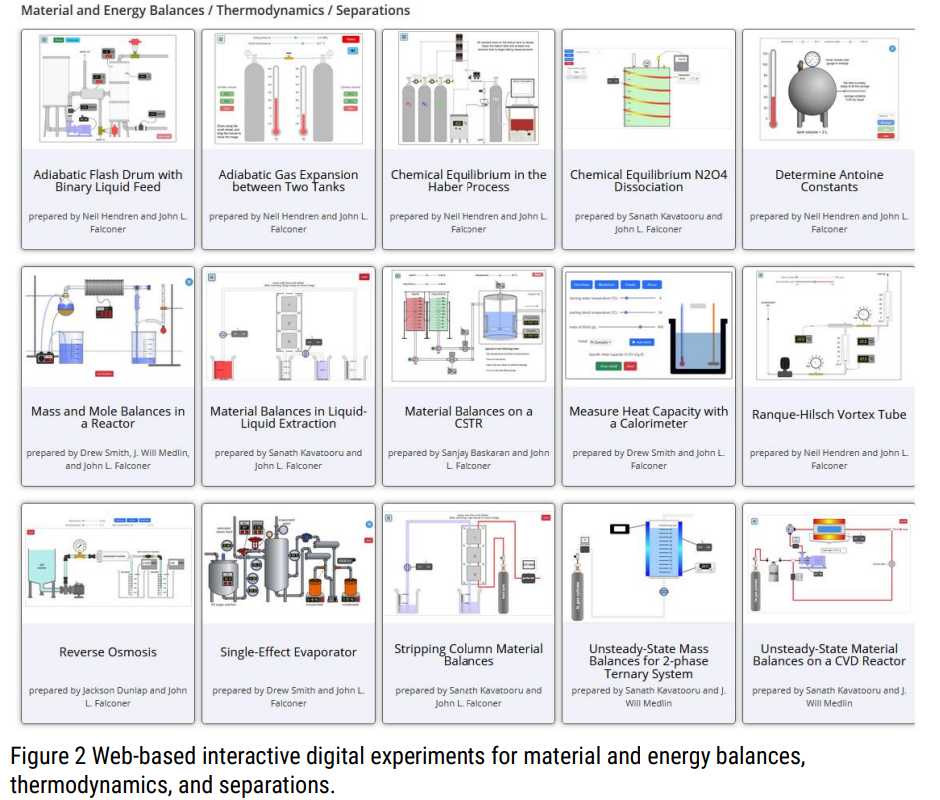
The objective of these digital experiments is to enable students to understand important concepts and skills. For the digital experiments that are mimics of the currently-available LCDLMs, the simulations’ interactive graphics are identical to the physical experiments. Students adjust valves and other equipment, take measurements (e.g., by collecting samples and reading meters), and analyze data. The digital measurements include noise in the data, just as in the physical experiment.
Though these digital experiments are for chemical engineering courses, the heat transfer, fluid mechanics, and thermodynamics experiments can also be used in mechanical engineering courses.
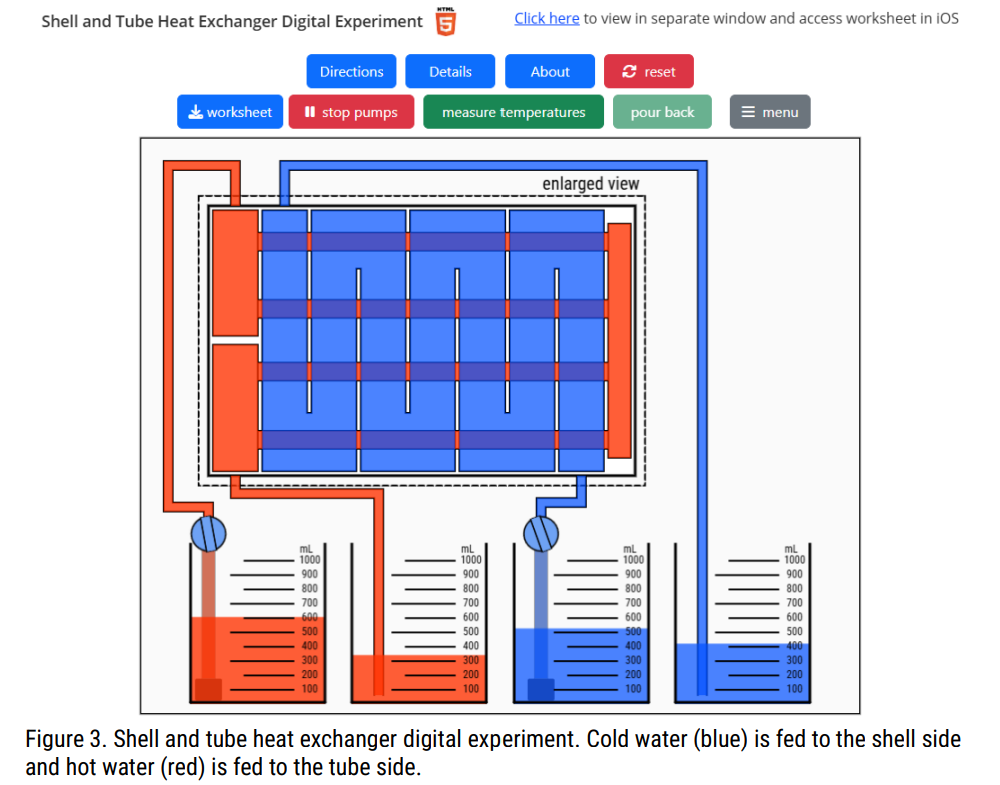
Figure 3 shows an example of a digital experiment for heat transfer. This figure shows the experiment in progress in which hot water is being fed from one beaker on the left (red) and the outlet water is collected in the beaker next to it. Likewise cold water (blue) is being fed from the beaker with a pump in the beaker and a valve above it and collected in the outlet beaker on the right. Students measure the flows rates of hot and cold water by measuring the volume changes as a function of time. They measure the temperature with a thermometer that is accessed by the button labeled measure temperature. This experiment contains a Direction button and a Worksheet button that downloads a detailed experimental procedure and analysis in a PDF file. It also contains a button that either starts or stops the pumps. The reset button allows students to start over and refill the feed beakers and empty the outlet beakers.
Digital experiments have numerous potential advantages over physical experiments:
- Easily scaled for used at multiple universities.
- Available at any time or location, including to students working remotely or at institutions that are resource-limited.
- Multiple students can use them simultaneously.
- Able to run experiments that are time-consuming for a physical laboratory. Procedures that 4 take a few seconds in a digital experiment would require many minutes in a physical experiment.
- Cost-effective: digital experiments are less expensive than physical experiments and easier to maintain, update, and improve.
- Able to make abstract phenomena more visible such as visualizing gas flow through tubing.
- Able to expose students to hazardous techniques and allow students to try different conditions without damaging equipment.
These digital experiments were programmed using JavaScript and HTML. They play directly in web browsers so that students can use them on laptops and tablets without downloading software or plug-ins. In addition to the digital experiments, more than 300 interactive simulations for eleven courses are available on the LearnChemE website https://learncheme.com/simulations/ . More than half of these simulations play directly in browsers; the others require a free plug-in


Theme by Danetsoft and Danang Probo Sayekti inspired by Maksimer